EXTRACELLULAR VESICLE BIOLOGY

Every cell is broadcasting. Exosomes are how the message arrives.

Nano-scale vesicles carrying proteins, lipids, and nucleic acids from one cell to the next — the body’s own signaling infrastructure for repair, regeneration, and immune balance.

30–150 nm

Typical vesicle diameter

1/1000th

Size of the donor cell

3 classes

Protein, lipid & RNA cargo

THE BASICS

A vesicle built to carry a message

All living cells, regardless of type, communicate with their neighbors. When the body needs to direct healing, repair, or regeneration, it packages the instructions — signaling proteins, lipids, and nucleic acids — inside a membrane-bound extracellular vesicle small enough to travel through tissue fluid and blood.

Once released, an exosome does one of two things: it empties its cargo into the surrounding extracellular fluid, or it docks directly onto a recipient cell and delivers its payload inside. This mode of communication is called paracrine signaling, and it’s how the body coordinates immune balance, tissue repair, and vascular growth.
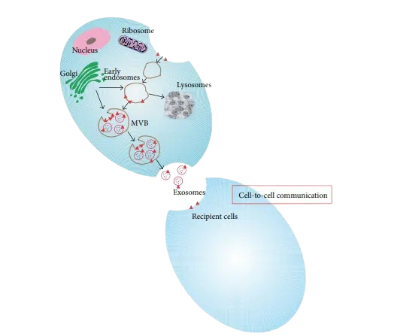
CELL-TO-CELL COMMUNICATION

What's inside the vesicle

Every exosome is a small, specific cargo hold. What it carries determines what it tells the recipient cell to do.

Proteins & Cytokines

Anti-inflammatory signaling molecules that help regulate the immune response.

Growth & Angiogenic Factors

VEGF, ANG1, and IGF-1 drive new blood vessel formation and recruit repair cells.

Messenger RNA (mRNA)

Carries the code for new protein production inside the recipient cell.

MicroRNA (miRNA)

Fine-tunes gene expression, and can silence specific targets altogether.

THERAPEUTIC SIGNALING

Five ways exosomes support repair

Through paracrine signaling, exosomes initiate distinct biologic processes — often several at once.

TNF-R1

Immunomodulation

Dampens an overactive inflammatory response, helping the body avoid excess tissue damage.

Wound Repair

Accelerates closure and supports the tissue remodeling that follows an injury.

VEGF · ANG1

Angiogenesis & Neovascularization

Signals the formation of new blood vessels, restoring circulation to tissue.

Fibrotic Remodeling

Helps reorganize scar tissue into a structure that better supports normal function.

IGF-1

Progenitor Cell Recruitment

Draws stem and progenitor cells toward the site of injury for long-term regeneration.

One Vesicle, Several Signals

A single exosome rarely acts alone — its effects compound with thousands of others.

FROM DISCOVERY TO THE CLINIC

A short history, an accelerating future

01

Discovery

First described in the scientific literature as vesicles released during normal cell maturation.

02

Isolation at Scale

Exosomes can now be isolated and purified from almost any tissue or fluid, including amniotic and cord tissue.

03

Off-Label Clinical Use

Physicians in regenerative medicine already use exosome-based products for wound healing and orthopedic injury.

04

Clinical Trials Underway

Active research spans inflammatory conditions, orthopedic repair, nerve trauma, and chronic disease.

TISSUE SOURCES

Where therapeutic exosomes come from

Not all exosomes are alike. Source tissue shapes the cargo — amniotic, placental, and cord tissue are especially rich in signals for repair.

Amniotic Fluid

Rich in mesenchymal stem cell–derived vesicles specific to tissue repair and regeneration.

Placental Tissue

A dense source of growth factors that support healing and reduce inflammation.

Umbilical Cord

Precursor-rich tissue whose exosomes are geared toward new cell growth and differentiation.

STAY CURRENT

Follow the research as it happens

Nano-scale vesicles carrying proteins, lipids, and nucleic acids from one cell to the next — the body’s own signaling infrastructure for repair, regeneration, and immune balance.